
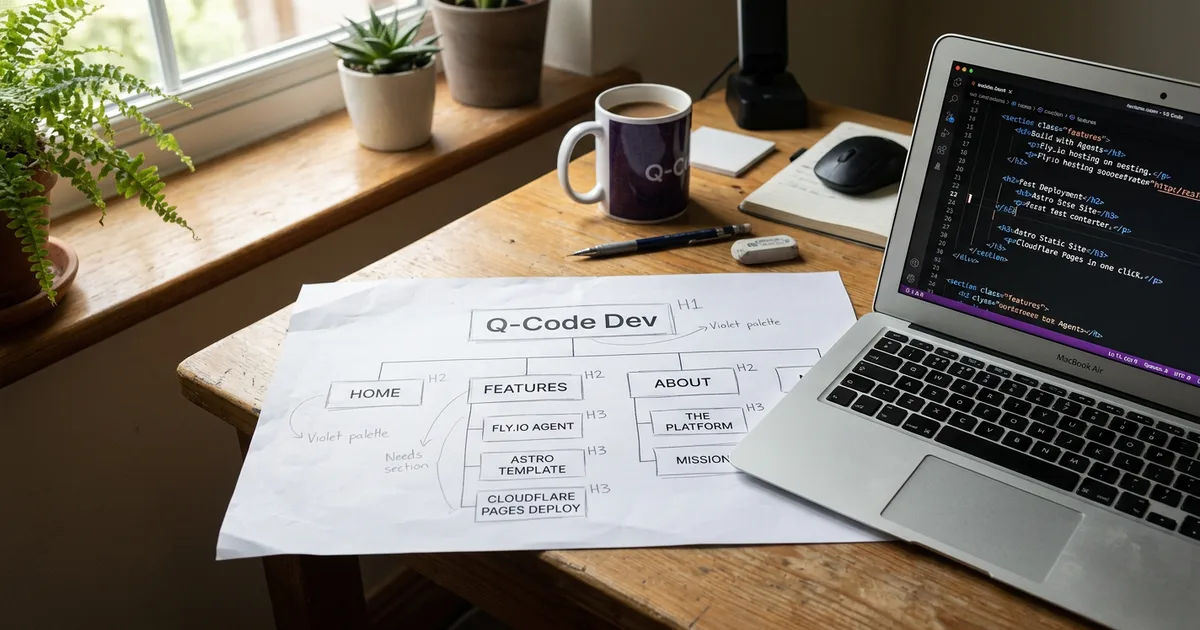
Give every page one job, answer its question in the opening paragraph, and lay the rest out as a heading outline at a URL that never changes.
The outline has to be in server-rendered HTML to count. Search engines index pages, not sites, and each page has to be self-contained enough to be crawled, understood and quoted on its own. Most indexing trouble on small business sites is not a technical failure but a structural one: several pages competing for the same question, answers buried under scene-setting, headings used as decoration, and text that only appears after JavaScript runs.
What “indexed” actually means
Four things have to happen before your page can appear in a result. A crawler discovers the URL, usually from a link or a sitemap. It fetches the page. It renders it and works out what the page is about. Then it decides whether the page is worth storing at all.
That last step is the one people forget. Indexing is a judgement, not a formality. Google will crawl a page, decide it duplicates something it already has or answers nothing in particular, and drop it. In Search Console this shows up as “Crawled, currently not indexed”, which is a polite way of saying the page did not earn its place. No amount of keyword tuning fixes that. Structure does, because structure is how you make a page distinct and legible.
The same logic now applies to answer engines. When an AI assistant cites a source, it is retrieving a passage, not a whole site. A page split into clean, self-contained sections gives it something to lift. A page that is one long undifferentiated argument gives it nothing convenient, so it goes elsewhere.
One page, one question
The most common structural fault on a small business site is topic overlap. A plumber has a services page, a boiler page, a “boiler repairs” page and a blog post about boiler repairs. All four mention the same three towns. None of them is clearly the answer to “boiler repair in Stroud”, so the search engine picks one more or less at random, or picks none, and the others sit in the index doing nothing.
Decide what each page is for and write it down before you write the page. One sentence: this page exists to answer X for someone who wants Y. If two pages produce nearly the same sentence, merge them. A single strong page that earns links and gets read all the way through will outperform three thin variations every time, and it is less work to keep accurate.
When you merge, redirect the old URLs to the survivor rather than deleting them. A 301 passes on whatever the old page had accumulated. A 404 throws it away.
Put the answer in the first paragraph
The opening paragraph of a page is the highest-value text you will write, because it is what gets pulled into a featured snippet, read aloud by an assistant, or skimmed by a person deciding whether to keep going. Use it to answer the question in the title, completely, in the first sentence.
This is uncomfortable at first. The instinct in commercial writing is to warm up: establish the problem, hint at expertise, then deliver. That order suits a sales letter and works against you here. If your page is titled “How much does a rewire cost” and the first paragraph talks about the importance of electrical safety, you have handed the snippet to a competitor who just said the number.
A useful test: read only the first paragraph aloud to someone who has not seen the page. If they still have to ask the original question, rewrite it. Everything after that paragraph is support, evidence and detail, and it can take as long as it needs.
Headings are the outline, not the styling
Headings tell a crawler how the page is organised. They only do that if the hierarchy is real: one h1 that matches the page’s subject, h2 for each main section, h3 only nested inside an h2. Skipping from h1 to h4 because the smaller size looked better is a formatting decision that damages a structural signal, and screen readers suffer for it too, since heading navigation is how many people move through a page.
Write headings as statements or as the questions a customer would actually type. “Our Approach” tells nobody anything. “What a full rewire involves” describes a passage and matches a search. Read your headings on their own, in order, with the body text ignored. If that list reads as a coherent summary of the page, the structure is sound. If it reads as a set of labels, the page has sections but no argument.
Keep sections roughly self-contained. A reader who lands on your page from an anchor link halfway down should be able to make sense of the section they arrive in without having read the two above it. That habit costs a little repetition and buys a great deal of quotability.
URLs that never have to change
A URL is a promise. Every link anyone builds to your page, every bookmark, every citation in a chat answer depends on it staying where it is. So make it short, lowercase, hyphenated, descriptive, and free of anything that will date: no years unless the content genuinely is annual, no /new-site/, no numeric IDs, no “2026-offers”.
Use folders to express real relationships rather than to signal depth. /services/rewiring is fine if there is a services section. /services/electrical/domestic/rewiring/full-house is a filing cabinet somebody built for their own comfort. Depth is not a ranking mechanism, but it does affect how many links a crawler has to follow to reach the page, and pages buried five clicks from the home page get visited less.
One URL per page of content, too. If the same content is reachable at a trailing-slash and a non-trailing-slash address, at both http and https, or with tracking parameters attached, pick a canonical form, redirect the rest, and declare it with a canonical tag. Duplicate addresses split whatever authority the page has and waste crawl requests on copies.
Internal links do the work a sitemap cannot
A sitemap lists your pages. Internal links tell a search engine which of them matter and what they are about. The anchor text is the strongest hint you get to write yourself, so use words a person would search for. “Read more” and a bare URL both throw that away.
Give every important page at least one link from a page that gets crawled often, which usually means the home page, a hub page or a recent post. Orphaned pages, reachable only from the sitemap, are technically discoverable and practically ignored. When you write a new article, spend two minutes adding links to it from the older pieces it relates to. That habit, kept up, is worth more than most one-off technical fixes.
Link out to your own relevant pages inside the prose where it genuinely helps the reader. On this site, a piece on structure sits next to the specific things that make a small business site slow, because a page that times out never gets indexed at all, and next to what belongs on a small business contact page, because the enquiry page is where the structure has to pay off.
Make sure the words are in the HTML
Google renders JavaScript, but rendering is a second pass with its own queue, and other crawlers, including several that feed AI assistants, do far less of it. If your body copy, headings and internal links only exist after a client-side framework has run, you are betting your indexing on the least reliable part of the pipeline.
View the source of your own page, not the inspector. If you cannot find your first paragraph and your h2 headings in that raw HTML, fix that before anything else. Static output or server-side rendering removes the problem entirely, which is one of the reasons a static host is a sensible default for a business site.
The same rule covers text in images. A price list rendered as a JPEG, a set of opening hours baked into a banner, a table of specifications exported from a spreadsheet as a PNG: all invisible. Alt text helps a screen reader and does not substitute for the content being there as text.
Structured data has to describe what is on the page
Schema markup is a way of restating, in machine-readable form, what a reader can already see. Done that way it helps: an FAQ block, a product, a local business, an article with its dates and author. Done as an optimisation, where the markup claims reviews or questions the page does not contain, it invites a manual penalty and the loss of any rich result you had.
The safest method is to generate the markup from the same data that renders the page, so the two cannot drift apart. If the FAQ list in your JSON-LD comes from the same array that draws the visible questions, deleting a question removes it from both. If it is hand-written JSON pasted into the head, it starts accurate and quietly rots.
Freshness signals only work if they are true
Include a real published date and, where you have made real changes, a modified date. Bump the modified date when the page’s meaning changes, not on every rebuild. A lastmod that moves every time a deployment runs tells a crawler nothing and gets discounted, which we have argued at more length in why your lastmod date is only useful if it’s true.
The indexing benefit of freshness comes from actually revisiting content: updating prices, removing services you no longer offer, rewriting a section that has aged. That is also the point at which you catch the pages nobody links to any more, and the two questions you now get asked that the page does not answer.
Be explicit about what should not be indexed
A thin, duplicated or purely functional page in the index dilutes the rest. Thank-you pages, internal search results, tag archives with two items in them, filtered variants of a product list: pick the ones that have no reason to appear in a result and mark them noindex.
Do it with the meta tag rather than a Disallow in robots.txt. Blocking the crawl stops the crawler ever reading the tag, so the URL can still surface without a description, which is the opposite of the intent. And keep noindexed URLs out of your sitemap. A sitemap is a list of pages you want indexed, and advertising a page you have told robots to ignore is the site contradicting itself.
A structural audit you can run this afternoon
Open a spreadsheet and list every URL on your site. For each one, write the single question it answers and the single audience it serves. Then sort by that question column.
Rows sharing a question are your competing pages: merge and redirect. Rows where you cannot state a question are candidates for deletion or noindex. Rows with a good question but a weak first paragraph are the fastest wins on the list, because rewriting an opening takes ten minutes and changes what the page is eligible for. Finally, check that each surviving page has at least one internal link pointing at it with sensible anchor text, and that its heading outline reads as a summary when you strip the body away.
That exercise takes an afternoon for a twenty-page site and tends to remove more than it adds. If you would rather talk it through against your own pages, send us the URL and a note about what you want each page to do.
Frequently asked questions
- How long should a page be for search engines to index it?
- There is no minimum word count, only a threshold of usefulness. A 300-word page that fully answers a specific question will be indexed, while a padded 1,500-word page that answers nothing in particular often is not.
- Should I use one long page or several shorter ones?
- Split by question, not by length. If a topic contains two distinct questions that people search for separately, give each its own page; if the second question only makes sense in the context of the first, keep them together under separate headings.
- Does the order of my headings really matter?
- Yes, for two reasons. A proper hierarchy helps a crawler understand which sections are subordinate to which, and heading navigation is how many screen reader users move around a page, so a broken outline is an accessibility problem as well as a structural one.
- Why is my page crawled but not indexed?
- Usually because the search engine judged it too similar to something it already holds, or too thin to be worth storing. Check first for other pages of yours answering the same question, then look at whether the opening paragraph actually answers the title.
- Do I still need an XML sitemap if my internal linking is good?
- It is worth having, since it helps with discovery of new pages and gives you a clean list of what you want indexed. It does not replace internal links, which are what signal importance and topic, and a page reachable only from the sitemap is rarely treated as significant.